Thursday, April 9, 2009

Will People Pay for Internet Content?


Image by American Physical Society

People are not likely to pay for content online if they know that what they want can be available to them for free. Internauts are just so used to free abundant information online. So if you ask someone to pay to get access to what you have to offer, I don't think they have enough trust in your product to be willing to give their money away. Trust between the user and the source is really important.

It is however understandable that people who make countless efforts to make information available have to get paid for their work. So the best way to go here is to find alternative ways to get rewarded.

A smart alternative that a lot of online businesses use is the donation model. When you give people a preview of what you are offering and they get used to you there is a certain trust that builds up and they will be willing to reward you. If they don't get the feeling that you are after their money, they are more likely to show you appreciation. A good example of the donation model is Wikipedia which started from nothing and got big thanks to the donations of users.

Based on personal experience, I have never paid when I couldn't get access to the source and check it up. Besides, I know that I can certainly find what I am looking for from another source for free. Aside from that, I have a blog myself and I don't think I will ever make people pay to see what I have to offer because when my stuff is out there it could bring me job opportunities I could never have otherwise. So I say it is a win-win situation for everybody. If not I can always find something else to do and earn a living of.

Wednesday, April 8, 2009

Free is Better Than Not Free


Image inspired by the UNFORGIVABLE series. Warning Not Safe For Work. Also, racist?


OR IS IT?!
As a poor student, it definitely is. If this recession is good for one thing it's the hot hot sales! But employment is suffering apparently. Whatever, I'm only a part-time bus boy for now and my in-province tuition is relatively cheap. I plan on cashing in big on my slow cooks blog anyways! And those who tried my slow cooker peach crumble probably have lots of faith in me.

Seriously though, I am having difficulty keeping track of what is being made free and what we should be paying for. In the peach crumble recipe link I just posted I mention that I got the directions from Beth Hensperger and Julie Kaufmann's Not Your Mother's Slow Cooker Cookbook. I was pissed when I got the link from amazon because it cost me $10 less than at Chapter's (which I bought with the refund I got on a text book I used all semester, ACE SCAM!, but also because I found out that the same book is available FOR FREE on Google Books. WTF?! Can everyone else read that book for free or is it just my Google account for some reason? If people are just going to post this kind of stuff for free, than I am abandoning my crusade of paying for things. Music, TV, newspapers and movies are one thing, but books? I didn't think I would be able to replace a good hard copy of a respectable cook book, but apparently you can.

I felt pretty good after reading Chris Kelly's article earlier in the semester about the uncopyable generatives, and really made me consider that pirating won't destroy our economy. Now I am not so sure. Are these generatives as reliable as he makes them out to be? I mean, immediacy is dealt with pretty well on the web, and the 100 000 people who downloaded Jackman's movie don't care much for authenticity. The online version of the cook book made me realize that maybe embodiment isn't really that important either, and other generatives are just as flexible. One for me that isn't though, is still PATRONAGE. I honestly feel kind of bad to get this stuff for free, but my wallet doesn't.

So what's gonna happen? I'm not sure, but if there's one thing this class has made me realize is that it needs to happen quickly. I am pretty sure the internet IS THE GREATEST INVENTION EVER and people need to harness and organize it more to their advantage. For me that may still include downloading television (c'mon I have no cable, they want me to watch TV), and downloading news, but I am also going to keep pushing this slow cooker blog as hard as I can/want to while it is enjoyable (or until I start making serious bank.)

Tuesday, April 7, 2009

"Let My Content Go!"

Felicia Day, probably best known for her role in Joss Whedon's Dr. Horrible's Sing-a-long Blog, produced a wonderfully quirky web series about online gamers. This isn't anything new or extremely revolutionary. I mean, who hasn't heard of Lonelygirl15? What's most interesting about Day's project lies in where she obtained her funding, i.e. how the girl got paid!

In her own words:


Oh, yes, it's happening. People are already paying for content. The difference lies in the sole fact that it is their choice. As paradoxical as Barry Schwartz might think it is, we, the people (and consumers), know what we like. Especially when it comes to art, entertainment and information. According to Lanier, designers and software engineers need to reformat the internet, attune the system to reassemble the free content and fair use initiative, possibly to make it kind of free content and maybe-sorta fair use. I fail to see how, once again, forcing people to pay for something uncertain is a move in the right direction. Looking at Felicia Day's project as an example, it seems as though Lanier hasn't really done his research.

As Kevin Kelly explains in Better Than Free:
Fans like to reward artists, musicians, authors and the like with the tokens of their appreciation, because it allows them to connect. But they will only pay if it is very easy to do, a reasonable amount, and they feel certain the money will directly benefit the creators.


True, Felicia Day creates television-style entertainment, and how does that have anything to do with Journalism? Here's the thing: Not all professional journalists are outstanding. Much like web television. Which then begs the question: Why should we have to pay for their content?

Instead, I think Lanier should have asked: Why should we charge? As there is nothing more affordable than free.

Saturday, April 4, 2009

Who Says Journalism is Dead?

All this talk about how journalism is dead is because we are approaching a breakthrough in the actual concept of news reporting. No one can back the claim that the way journalism was sufficed?

There are so many problems with the current "dying" system:

  • Consolidation of media outlets resulted in an information monopoly of newspapers held by a handful of powerful families.

  • The interests of investors who owned shares in these converged companies have influenced what news is reported.

  • Advertisers have also gained a bit of leverage in what makes the news.

  • The audience has become discouraged with the media and have moved to the web to find more independent news media

  • Many journalists who blog for free are part of the angry audience who are passionate about informing the masses.


Moving forward is a risky operation with a chance of great losses and setbacks. Pay Me For My Content is an editorial by Jaron Lanier, that rustled the feathers of the Jouralism community. More people accept the fact that things need improvement and online is the trend. Working with this we need to put forth a feasible plan and the optimistic encouragement to embolden people. Confidence is the only way we will convince investors to support experimental projects in the current recession.

First we have to understand WHY we need a new system. I outlined this earlier, but there have been books like Media, Profits and Politics: Competing priorities in an Open Society (Harper and Yantic 2003) and Journalism: Critical Issues (Allen 2005) written on the topic. One could dapple in it for quite some time; all you really need to know is the North Atlantic Model of news is old news. (See Hallin and Mancini's "Comparing Media Systems"; 2004.)

With this knowledge we can easily recruit the WHO. This step has already been jump started online in the form of blogging. People are taking on journalism as a hobby, but it is time consuming, The affordable and accessible qualities of online journalism enables those anyone with free time to report.

Unfortunately, in the current system good journalists are not adequately recognized for their exceptional abilities except by their audience size. They don't have enough funding to really expand their capabilities and make it worth their time and efforts. Noteworthy successors who have achieved somewhat sustainable systems include The Huffington Post and Montreal City Weblog (by Kate McDonnell). These blogs have built a prestigious name for themselves, but they often only scrape by. Some, like McDonnell, have not monetized their blogs at all in spite of their large audience.

WHAT can be done to change all this? The PEW Research Center's annual State of the News Media 2009 report show the advertising money is going towards online investments and cable companies over newspapers. The final obstacle we have to overcome is discovering how to profit from this audience. This economic step is the final, most difficult in the process of rebuilding journalism.

All in all, this uncertainty and change will be most beneficial to the practice of journalism. It will revive the integrity of journalists. It will allow for more localized community based systems that can to work together with others in a global media web, while allowing for more specific audience targeting. It could become a more equalized system too, where news is reported according to its true worth and the media net is more evenly dispersed. Such a project under experimentation is the sustainable system Patch.

These systems need to be interconnected with national and international partners to complete the sustainable web. The Internet provides the perfect setting for truly democratic news. Ironically, it may be the infinite trait of this form of telecommunications itself that leaves us hesitant. We have to all move forward together or there will be no hope for progress.

WHEN AND WHERE? Well obviously this is all happening here and now. Those of us passionate enough to revive the media need to jump on the wagon. We can't hang ourselves by mocking the present situation and drowning out our importance and credibility. We need to take this step confidently so that the masses will follow suit. Change is scary but it is usually a good thing and most people understand that now. Journalism economists just need to find that price that people will pay that is not too high but still worth our service to them.

This is not even to say newspaper is out. Once online media begin making significant profits, they can produce free print editions or, more modestly, special weekend editions. However, we are not paying for the (wasted) paper; we are paying for the information and the transparency good journalism creates. That demand will never die. Journalism will never die.

Friday, April 3, 2009

Patience is a Virtue: We Will Get Paid, Eventully


Photo courtesy of RoweBrownWedding

"Through patience a ruler can be persuaded,and a gentil tongue can break a bone."
-Proverbs 25:15

We live in an instant everything world. If we don't get what we want immediately we cry, whine and stomp our feet. O.K. maybe I'm exaggerating a little here. Or am I? I believe we have evolved into an immediate gratification society . Or, maybe we always were and now I'm just more aware of it. After all, there is an abundance of free Internet information out there on the subject.

In Jaron Lanier's article, Pay Me for My Content , he states that, "Information is free on the Internet because we created the system to be that way". That may be true, however that doesn't mean I don't ever want to get paid for my work on my Montreal Theatre blog . Although that would be nice, it doesn't have to happen right now in order for me to continue writing about the theatre scene .

In a response to the same article Bryan Milonja points out in, "Blogging for Money: Think it Over" , "It's true that some people do make a ton of money blogging, but the truth of the matter is that most people don't." I certainly agree. I have discovered that blogging is really a fun and creative activity to do. So if I were to ever make money from this awesome adventure, it would be an added bonus.

Although, I will have to wait. Maybe even wait a long time. Eventually, if I stick with it and write about what I am passionate about it will show, and yes, maybe payoff. Consistency in writing, blogging or anything for that matter builds character and confidence in ones self, as well as your audience. It is also about self discipline , focus , passion and a desire to be heard.

Getting Organized

- Have a special, uninterrupted time set aside to write and then go to it.
- Turn off the phone if you are unable to resist answering it.
- Take time each day to prepare and get organized before you begin to write.
- Once prepared just start writing.
- Don't worry to much about spelling right away. Just get those ideas flowing.
- Stick with it and always save your work.

In our Concordia citizen journalism course this past winter, teacher and Illustrator Matthew Forsythe had mentioned that, he can tell who's passionate about what they are writing about on their niche blogs . I think we all feel it on some level when an article or other written piece lacks energy and zing.

I can also tell for myself when I am writing something that is free flowing, exciting, and driving me to succeed. I am happy, willing and want to work at expressing some point better or stronger . Not settling until it is expressed perfectly. I find it really gratifying to explore our language and find the ideal word or words to express what it is I want to say. So, blogging is right for me.

The fabulous guest lectures Matt brought in, Kate McDonnell of Montreal City Weblog , Journalist Craig Silverman, of Regret the Error , and Sean Michaels, of Said the Gramophone , all share success that comes from hard work and dedication. Work that is sometimes rewarded financially and sometimes not. Yet always rewarding.

Thursday, April 2, 2009

Blogging for Money: Think it Over


I've decided that I won't be blogging for money any time soon.

After countless hours of conducting research on how to make blogging profitable (ex: see video above), it's people like Sean Michaels who have convinced me that not blogging for money might just be wiser.

A while back, Michaels ultimately took the decision not to create a business model for his successful Said the Gramophone blog.

By focusing on producing well-written posts and having fun with his blog, he was able to gain quite an audience. The result? Lots and lots of freelancing opportunities.

By being passionate, persistent and consistent about his blogging, Michaels now finds himself writing for a living and loving it. Kind of sounds like what I want to do....

The Realities of Blogging for Money

As I was conducting my research, I stumbled upon Darren Rowse's article on the realities of blogging for money.

Rowse, a pro at blogging for money, provides a great list of things people should consider before trying to make money blogging. Here are a couple of his key points:
  • Building a successful blog takes a long time.

  • Blogging for money takes a ton of work and knowledge.

  • Keeping a blog going on a consistent basis is extremely difficult and takes a lot of dedication.

  • Most people don't make much money blogging.
It's true that some people do make a ton of money blogging, but the the truth of the matter is that most people don't.

Clearly, there is an opportunity for me to create a decent business model for my Trampoline Canada blog. However, for now I'm going to be blogging for fun, not money.

I think blogging for fun is the best business strategy for me. If I'm able to make a really good impression on people through the content of my blog, I might just convince a person or two to offer me interesting career opportunities in the future.

Will people pay for Internet content: Yes and no!


In the short history of the Internet we have been used to that almost everything is free of charge, and as long as it is floating around with free alternatives I don´t see that changing. Still, I think that there is a future for some specific content that users will be willing to pay for. 

Computer scientist Jaron Lanier writes in the article Pay me for my content published in New York Times, that software engineers and Internet evangelists should design information systems where people have to pay for the content and refers to "delightful ecosystems" as Second Life or the ecosystem of the Ipod. 
I just have a hard time picturing that software engineers for ideological reasons suddenly will shift into making information systems where one has to pay for the content. Information as news will never be paid for even how delightful the ecosystem is, when you can get the same news for free somewhere else. 

In my opinion there is mainly three different niches on the Internet where there is a good chance that people gladly will pay and already are:

  1. Movies or games in high quality
  2. Exclusive articles or rapports from respected authors or medias who can give insight in a specific subject which can´t be found anywhere else. 
  3. Online communities as in games or dating or more exclusive ones where you can feel part of a group that reflects your personality or that allows you to get in contact with certain people. 
What the three niches offer is either quality that cannot be found anywhere else and/or the opportunity to get in contact with people through a certain interest. I sincerely hope that Jaron Lanier and his colleagues find a way to get writers and artists paid for their content besides from adds but they have to come up with something quite unique when it´s competing against alternatives that are completely free. 

Wednesday, April 1, 2009

Paying for Online Content: An Eventual Evolution?

(pic via www.slate.com)

To Pay or not to Pay?

People will not pay for web content. We cannot create information systems where people pay for online content, or can we? According to Jaron Lanier, journalist and author of "Pay Me for My Content", "information could be universally accessible but on an affordable instead of an absolutely free basis". Nikesh Arora, president of Google for Europe, Africa and the Middle East, agrees with Lanier suggestion of charging people for Internet content. In fact, Arora believes that "the web economy will evolve just like the print economy, which means that people will eventually pay for content online".

Take the bad with the good

ConsumerReports.org, MLB.TV, and ITunes are just a few well-known examples of paid sites that are fruitful and prosperous. However, paid content's failures are also well-documented. In "Not all Information wants to be Free", author Jack Shafer enumerates a few "paid model" sites that plummeted in that last decade:
"Slate gave up on the subscriber model in early 1999.The New York Times folded its TimesSelect product of columnists and archives in 2007, concluding a two-year run. The latimes.com set free its Calendarlive section of arts, reviews, and listings in May 2005[...]Inside.com, which charged several hundred dollars a year, failed to attract its 30,000 desired subscribers and expired."

Make money online

Despite the high rate of failed "paid content" sites, it is still possible to make money online by writing. In "Make Money Online-6 Websites that Pay Writers", author Dave Ickes lists 6 websites that actually pay writers for their skill. For example, SSWUG.org is a technology focus website that pays a minimum of 20$ per submitted article.

Twitter Me This, Guardian.

Finally! A newspaper has got the right idea! While our very own colleague Louise laments about speed destroying credible journalism, it seems the winds of change have picked up their gusts. Is the expectation of quick reporting truly the culprit? Or is it the length of the stories? If journalists were required to pare their pieces down straight to the nitty-gritty details, then fact-checking could take precedence.

Are You Nuts?


Yes, but we have, over the last few decades, fashioned our society into one that appreciates brevity and the optimal use of time. It takes time to gather facts, it takes time to check them, it takes time to write them in a way that displays a journalist's integrity, talent and je ne sais quoi. It also takes time to re-read, to edit, to edit some more; and this goes without outlining the time it may take for a story to be formatted for whatever medium it might find its way onto.

And now...

Enter The Guardian


The renowned British newspaper has decided to move away from its print legacy and take flight on the wings of new media. That's right. The Guardian, available only on your trusty Twitter feed and no other. Granted, this does seem an awful lot like a joke, but it really just looks like serious journalism's first attempt to embrace what is slowly gaining ground on them. By harnessing Twitter's platform and the public it reaches, perhaps The Guardian is onto something. The speed and limitations of the live, 140 character-long feed might be a challenge, but what journalist would shy away from one of those?

Besides, most of us lay-people, or "citizens", tend to go trough the headlines first anyways. I don't see how this is such a huge leap. We are already bogged down by choice's paradox, at least this way, with succinct bursts of news, we can be free from the paralysis of choice. We can choose all. Why? Because it takes no time.

So thank goodness for The Guardian! And as they say: "If you can't beat 'em, at least you can avoid the fail whale."


Image Courtesy of CC Chapman.

All Complaint, No Suggestion

I am irked me about Pay me for my Content. I am irked because while he might be making some good points about creators not getting paid, and he might have some points about how advertising isn't the answer- but he has no real suggestions for what could be a solution.

If you want to be part of the solution, perhaps come up with some suggestions as to what could be done to rectify the situation?

Now, advertising more isn't the answer. I doubt there's hardly anyone left out there who will still click on ads anymore, and we've trained ourselves to ignore them while we explore the interwebs. Perhaps subscription fees for certain products could be successful, but oftentimes they just make viewers annoyed, because they can simply find the content elsewhere.

However, I think there is a group of people out there who have the right idea, and they are webcomic creators. At face value, they seem to be giving their content away for free- but are they really? Many webcomics have areas in which you can donate to them, which many people (including myself from time to time) have done. Another option they use is to create special content for people who donate, or subscribe. For some, special desktop wallpapers for your computer, others, such as PvP, have a fan club that someone can join for a small monthly fee, which then gives the subscriber access to special content, such a videos, and applications. Webcomic creators also try to connect and interact with their readers, by going to conventions, and selling sketches and products.

At face value, they're giving away their content for free. But they have an array of pay-to-see options that extend their content. Most profitable ones sell tshirts, hard copies of their comments, figurines, and the like. Perhaps a similar business model could be modified and applied to journalism, giving the basic content for free, while enticing the reader with more deluxe options.

Scarcity and Vision Creates Cash Worthy Internet Content!


Picture Courtesy of: www.maximumpc.com

It's Time To Shift Our Expectations

"The Cream Rises To The Top," what more is there to say. The Internet is a tool that needs to be mastered and like every tool, more money will be spent for better quality and the better the quality the higher the price. Think of the Internet as a huge retail store where the most expensive stuff stems from demand but low availability, if you can produce something that's better, you'll get paid, if not, you'll be sitting on the shelf. We need to shift our expectations, instead of what or how can the Internet work for us, we should ask, what can we bring or add or create for the Internet?

For Better or For Worst

The Internet is not what we hoped it would be and like most things in life that are anticipated, disappointment often ensues. The time has come to accept this and move on and use the Internet to our advantage to promote ourselves, create visibility, participate, reach-out and respond to the existing community. Anyone who is able to do all of those successfully understands the value of the Internet. These people aren't complaining about not getting paid because they are getting paid, the online community pays respect and that's about all the Internet can really do and that should be enough, that should be satisfactory.

Is It Just Me?

There's something wrong with believing that you deserve to be financially compensated for work that you would have done either way. Plus, what makes people think they are so special that the Internet community will somehow gather around their content and actually want to pay for it when everything else on there is free?

The economics of scarcity, reveals so much about why people are willing to pay for certain things, because they can't get it anywhere else! That's why making money online is practically impossible, because nothing on the Internet is scarce enough to entice people to pay for them, you're writing included.

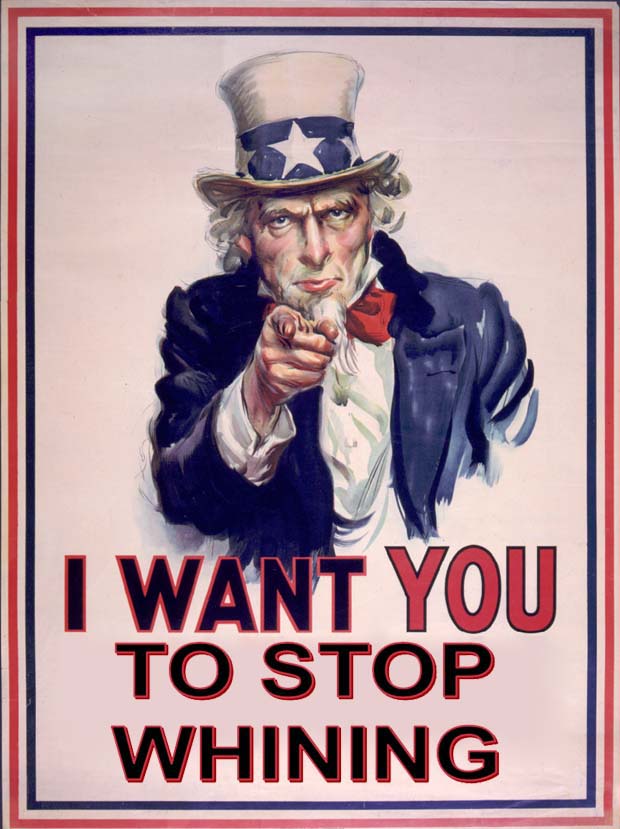
Whiny Journalists Go Nowhere!!!

This image was stolen from: Sonofthesouth.net

Part 1.
"I'm mad as hell and I'm not going to take this anymore!"
  • I’m sick of reading whiny articles by whiny people who say there’s no money for the online journalist. You’re right, there’s not.
  • If you think a RealPeopleNewsLocal.blogspot.com is going to make you money - you’re living in a delusion. Buy a ‘.com’ domain and try your luck.
  • Think GoogleAds are going to pay your rent – they’re not. No one is going to click on a stupid GoogleAds Ad…they’re ugly and make pennies.
Let's get real. Only talented people are going get ahead online.

If you want to make money, you've got to have something tangible and unique.. like Da Beef Bucket's Monthly Mouthful - now that's quality! It's all about shameless self promotion and milking the digital cow. If you can milk it, make some fine online brie and serve it up to rich yuppies then you really got something. 

If not, you're probably not cut-out for journalism anyways, or an online market.  So you should think about working in the trades or something. It's a sink or swim world out there and not everyones dream comes true.

The best thing and aspiring online journalist can do is try their luck in the online pool. If it doesn't work out than leech onto a physical media outlet because it's what untalented writers have been doing for years. They will pay you regular wages and will one day find out how to make money online.

Part 2.

Coming soon...maybe later tonight.

Avoiding mistakes with The Elements of Style

Craig Silverman says that when errors are published in a newspaper or magazine, they "erode credibility." While Silverman is talking about factual inaccuracies, I'd like to draw attention to some things that makes me squirm: bad grammar and spelling mistakes.
I write for, and have recently been named an editor of, a certain student publication. I am a journalism student with a view to, somehow, wrangle myself writing jobs one day, and every piece I have published in said publication is a precious addition to my portfolio. Which is why I get so angry when mistakes are actually added to my articles by hapless editors. While it's infuriating on a personal level, it's also frustrating because it makes the student publication seem like a very laissez-faire, non-serious paper.
A 1998 study by the American Society of Newspaper Editors found that "each misspelled word, bad apostrophe, garbled grammatical construction, weird cutline and mislabeled map erodes public confidence in a newspaper's ability to get anything right." Exactly.

That's why I propose everybody buy themselves a copy of The Elements of Style by William Strunk Jr. and E.B. White - more specifically, the newest edition illustrated by amazing New York artist Maira Kalman! So beautiful, you'll want to look at it even when you don't have a stylistic query!

Original Style author Strunk (White added to later editions) provided surprisingly wry examples for every "element." A humourous and pithy man indeed.
Kalman's illustration for:
Well, Susan, this is a fine mess you are in.


May I never have to write an angry letter to the copy editor again!

To Pay Or Not Pay: That Is The Question

Let's be realistic: if we're already used to getting a good deal of information online for free, then why go back to paying for information? To expect people to voluntarily agree to pay for content now is a pipe dream. To expect this plan to work is even crazier!

I understand that writers need to get paid. And yes, we'll have to find more creative ways to get our hands on the loot. Whether or not it's through changing the information system under which we currently operate remains to be seen. It's a pretty creative solution, though.

Forcing the change on users, I believe, will be extremely difficult for the following reasons:
  1. There are many too many software designers out there: Just as one can create a system where content has a price tag, someone else can create the opposite as well.
  2. Who says users will accept it with open arms? You may get a backlash from users who may just boycott the product altogether.
  3. You would have to offer a real good incentive for users to even consider affordable over free.
  4. How do you qualify incentive? How do you quantify that?
  5. All writers or producers of content on the Internet would have to be on board in order for this to have any substantial effect. That's unlikely.

Jaron Lanier's Op-Ed piece Pay Me for My Content should at the very least have us thinking about different ways of earning income from our work. Or perhaps offer a different perspective on how our work can be a gateway to more income. It's something to think about...

In this video of the show Conversations with History Jaron Lanier talks about the implications of technology on culture along with the communications revolution.


Crowdsourcing and Traditional Photographers Suffering

Howe’s article focuses on traditional photographers (still functioning in the physical realm of the marketplace) and how they are are suffering. Such artists are suffering because they are loosing business due to the popularity of crowdsourcing, which comes hand in hand with widely-used online networks like iStockphoto. iStockphoto is a place that fosters talent; talent that just needs to be tapped into by people who are seeking it. When someone taps into an online network like iStockphoto for business it’s not a matter of outsourcing, it’s an affair of crowdsourcing.

Crowdsourcing is a direct phenomenon that comes about due to online interfaces like iStockphoto. Though, if it wasn’t for iStockphoto’s popularity crowdsourcing wouldn’t thrive. Crowdsourcing expands, grows, requires and feeds on popularity. When something is popular it is because it is accessible by many people. In fact, it's accessibility (having the means like an internet connection and a computer, etc) that give people the oppurtunity to transition from one identity to another, i.e. going from 'traditional artist' to 'iStocker'. iStockphoto’s popularity is thus because of technological advances in everything from product design software like Photoshop to digital video cameras and computers. As one devoted iStocker says, 'things are going well professionally and personally so thats that. I plan on getting accepted to iStock finally with the help of this new camera.' With technology, many people seeking to become artists are heading to iStockphoto to do so (only increasing iStock's popularity). With products and services readily available to the public at fair prices pools of talent are able to emerge. With pools of talent, people can then 'crowdsource' such pools in search of what they are looking for.

In Howe’s article, one could feel bad for traditional photographers (who for instance, are not linked to any online network like iStockphoto). These traditional photographers appear as victims to the likes of iStockphoto and crowdsourcing, who in turn take business away from them.

Real life scenario and Reality of Crowdsourcing

Character (a.k.a. Victim): Mark Harmel, a freelance photographer not technologically linked to any online network.

Character: Menashe, who works with the National Health Museum.

Characters Connect: Menashe is putting together a series of interactive kiosks devoted to potential pandemics like the avian flu and wants to utilize Harmel’s photographic talent.

Plot Thickens: Harmel offers the museum a generous discount on his work: $100 to $150 per photograph. “That’s about half of what a corporate client would pay,” he says.

iStockphoto (a.k.a Suspect) enters into the scene.

Climax: Menashe crowdsources. She then e-mails Harmel regretfully saying the deal is off as she discovered a stock photo site called iStockphoto. She wrote, “which has images at very affordable prices.” The same day, Menashe licensed 56 pictures through iStockphoto – for about $1 each.

Conclusion: With iStockPhoto now with about 22,000 contributors to its site (charging between $1 and $5 per basic image) non-connected photographers are finding themselves not only network-less but client-less because of it. iStockphoto is a manifestation of talent, talent that just needs to be tapped into and waiting to be crowdsourced.

Consequences of Too Many Choices

In this interview Schwartz makes known that that with too many choices people can’t choose at all. Schwartz agrees that choices are good; that they are a part of human life, but also argues that with so many choices it can become paralyzing to people. Most people would believe that the more choice people have the better they are, and this seems perfectly reasonable. To Schwartz though this is all too problematic. Here are two (only two) consequences of having too many choices.

consequence #1:
So even if you overcome paralysis (the overwhelming amount of choice, i.e. having to decide from 200 cereals) by making a ‘good’ decision (finally choosing a cereal) you will end up

less satisfied because you’ll probably end up thinking about the other other selections that you could have went with (i.e Fruits loops and not Oatmeal).

consequence #2:
With too many choices to choose from you’ll probably end up adopting a strategy to simplify the task of choosing on the basis of criteria that may be easy to evaluate. Despite the fact that such criteria may not be the most important criteria.
Example: It’s like purchasing a brand of cereal because of its pretty packaging. The packaging of a cereal box though is a poor factor to evaluate cereals on. Though a poor factor to make a decision on, the packaging of a cereal box is a noticeable thus making it a simple and quick way of evaluating and comparing one cereal to another. On the other hand, choosing a cereal on the basis of important criteria like its nutritional value is far too time consuming (involves reading and not just looking) and requires more energy (consumers need to take the cereal box and flip it to the back in order to read it). Evaluating cereals by their packaging proves to be more efficient by taking less time, so most consumers opt for packaging as a way to evaluate cereal boxes rather than important criteria like a cereal’s nutritional value.

It's not just Schwartz who has noticed the overburden of choice. In this
article researches (from a health perspective) noticed the consequences of having too many choices. Researchers here found that the more choices that shoppers (subjects in experiment) had made earlier in the day, the worse they performed on the math problems. Researches concluded that people faced with numerous choices, whether good or bad, find it difficult to stay focused enough to complete projects, handle daily tasks or even take their medicine.

It's in this
article where Schwartz offers some soothing consumer-purchasing advice for us by explaining, 'study the options, then settle on something you feel good, if not perfectly, about; let informed sources like Consumer Reports choose for you; don't compare your acquisitions to others'; and don't wallow in regret.'